
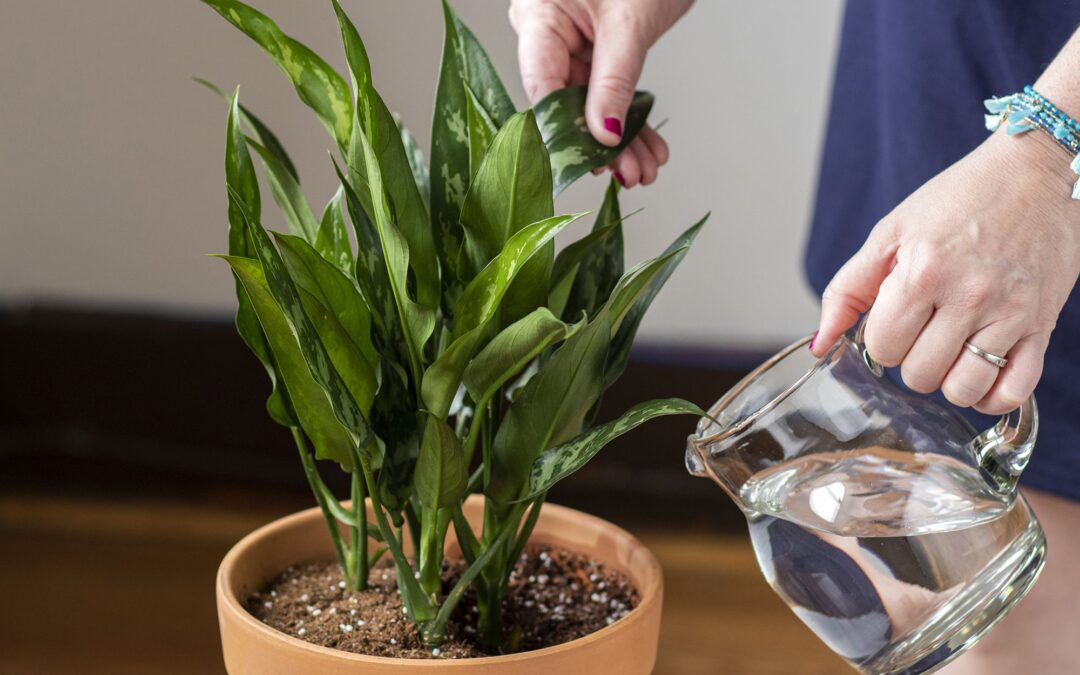
One of the main mistakes we make when watering plants is to treat them all the same. Never forget that each plant has its own needs and some need moderate watering while others need abundant watering.
Having said that, as soon as you buy a plant, check on the Internet or at the nursery where you bought it, what care it needs. Once you know what its needs are (abundant, moderate or scarce watering), you will be able to understand it and give it what it needs.
HOW TO KNOW WHEN TO WATER PLANTS
We could say -in a very summarised way- that there are three types of plants in relation to watering: those that need to be watered when the substrate is completely dry, those that need the substrate to be always wet and cacti and succulents that need long periods with dry soil.
Identify which of these three types of plant is yours and water accordingly. To do this, always look at the substrate and stick a toothpick, pencil or your own finger into the soil to see if the soil is moist or dry. If there is soil sticking to the stick or pencil when you pull it out, it is still wet.
In case you are not sure whether the soil is wet or not, my advice is to wait a few days, it is better to under-water than over-water!
WHAT IS THE RIGHT WATERING FREQUENCY?
The plant itself will tell you how often you should water it. Imagine you have a plant that needs to have a moist substrate and you water it every Sunday. In this case there could be three situations:
- Sunday arrives and the soil is dry. This means that you will have to water your plant twice a week instead of once a week.
- Sunday arrives and the soil is very wet. This means that you either have to water it less or you have to water it every 10 days.
Come Sunday and the soil is slightly damp. This means that you have found the perfect days to water your plant.
ADAPT YOUR WATERING TO THE TEMPERATURE
We always insist that the best thing for our plants is to observe them to understand their needs. Don’t get used to watering them one day a week – the example above was just that, an example – because depending on the time of year their water needs will change.
In the summer the temperatures are higher and you will need to water your plants more frequently to keep them hydrated and cool.
In winter the temperatures drop, the substrate stays wetter for longer and the plants go into vegetative rest, so we will reduce watering (always progressively) and even stop watering them almost completely in some species.
HOW MUCH WATER SHOULD I ADD?
This depends on many factors such as the size of the pot, the substrate, the type of plant (Ficus, Calatea, Succulent, Cactus…) or the temperature/time of the year.
However, in order to have an orientation that can serve as a guide, it is very useful to look at the drainage hole. In other words, water your plant until water comes out of the hole in the pot. When you see that water starts to come out, it means that it has reached the roots and that the amount of water is adequate and sufficient.
WHEN YOU POUR THE WATER IN, DO IT A LITTLE AT A TIME.
To avoid saturating the soil and overdoing it with water, it is advisable to pour the water into the pot a little at a time and see how it is absorbed by the soil and stop when you see that the water begins to run out of the drainage holes.
It is possible that when watering several plants you will notice that some absorb the water very quickly, while others take a few seconds to “swallow” it. Don’t worry about this, it is due to the amount and type of soil in each pot.
However, caked substrates, which usually have very compact soil, take a long time to absorb the water and you have to make sure that the water drains through the hole in the pot because sometimes, because the soil is so caked, the water cannot penetrate to the roots and the plant does not hydrate.
WHY DO PLANTS NEED TO BE ALLOWED TO DRAIN?
Not allowing the plant to drain is one of the biggest mistakes you can make when it comes to watering. What do I mean by draining? Always, always – I say it again just in case – always, always let the remaining water from watering drain out of the drainage hole before putting the plant back in its potting cover.
Likewise, don’t leave your plants with the saucer full of water as many species are prone to root rot and having stagnant water so close to them will lead to rotting or fungal problems.